







Forex EA Meaning Explained: What is an Expert Advisor?


Forex EA Meaning: The Definitive Guide to How Expert Advisors Work
If you’ve heard traders talking about ‘EAs’ and felt lost, you’re in the right place. Understanding the true forex ea meaning is the first critical step for anyone considering automated trading. It’s a world filled with potential but also significant risk, and clarity is your best defense.
Many traders simply want to know the ‘forex ea full form,’ which is Expert Advisor. An Expert Advisor is a piece of software, often called a ‘trading robot,’ that automatically executes trades in your forex account based on a pre-programmed strategy.
But a simple definition isn’t enough. The internet is flooded with hype and unrealistic promises about EAs. This guide goes deeper, cutting through the jargon to explain what an EA truly means for your trading life—from its simple logic to the psychological shift it requires. We’ll provide the definitive, objective answers that competitors often gloss over.
You’ll learn what an EA is in plain English, exactly how it ‘thinks,’ the crucial difference between an EA and a ‘Forex Robot,’ and the core pros and cons you must consider before risking a single dollar.
What is a Forex EA? The Simple Definition
So, what exactly is a Forex EA? Before diving into technical terms, let’s use a simple analogy.
Imagine you have a perfect, time-tested recipe for a cake (this is your trading strategy). A Forex EA is like a robot chef you install in your kitchen (your trading platform). You give it the recipe, and it watches the pantry (the market) 24 hours a day, 7 days a week. The moment all the right ingredients are available and the oven is at the perfect temperature (market conditions are met), it automatically bakes the cake (executes the trade) for you without any help or emotional hesitation.
Now for the more formal explanation. Technically, an Expert Advisor is a script written in a specific programming language, most commonly MQL4 or MQL5 (MetaQuotes Language). This script runs exclusively on the world’s most popular retail trading platforms: MetaTrader 4 (MT4) and MetaTrader 5 (MT5). Its sole purpose is to automate a trading strategy, handling everything from analyzing market data and identifying opportunities to placing, managing, and closing trades according to its coded rules.
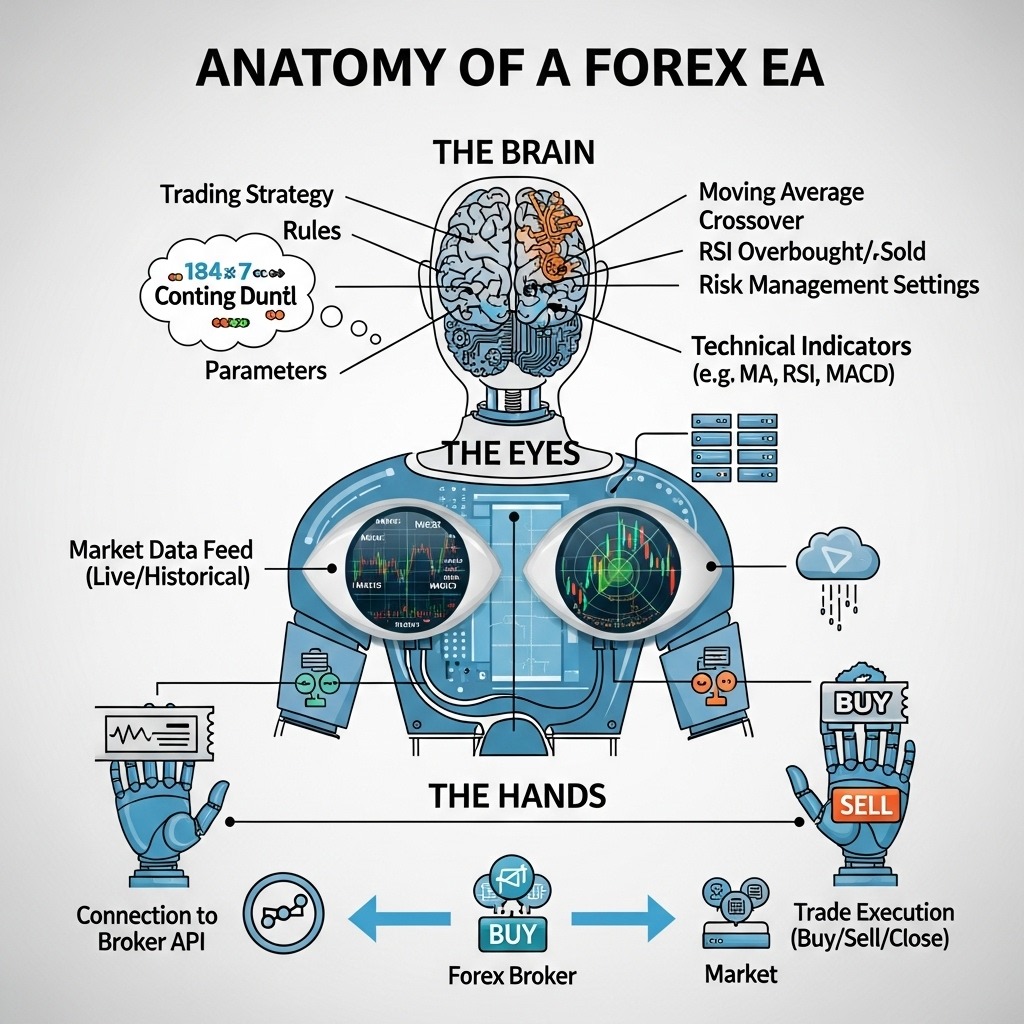
Understanding this basic meaning is the foundation. Now that you understand the basic meaning of a Forex EA, you can explore the various types and strategies in our Ultimate Guide to Forex Expert Advisors (EAs).
How an EA Thinks: The Simple ‘If-Then’ Logic
An EA isn’t driven by magic, intuition, or artificial intelligence in the way most people think. It’s powered by pure, cold logic. At its core, every Expert Advisor operates on a simple but powerful principle: ‘If-This-Then-That’ (IFTTT). It is a tireless scanner, constantly checking the market for the specific ‘If’ conditions that its programming defines as a valid trade signal.
When those precise conditions are met, and only then, does it execute the ‘Then’ part of its command—the trade itself. This removes all guesswork, fear, and greed from the execution process. To make this tangible, let’s look at how an EA would process a couple of common trading strategies.
Example 1: A Simple Moving Average Cross Strategy
How does an EA trade one of the most common strategies?
A moving average crossover is a classic trend-following signal used by countless manual traders. For an EA, it’s a simple set of instructions. The EA continuously monitors the price chart, calculating the value of two moving averages with every new tick of data.
The logic would be programmed as follows:
- IF the 50-period moving average on the 1-hour chart crosses ABOVE the 200-period moving average…
- THEN execute a BUY trade with a predefined 50-pip stop loss and a 100-pip take profit.
The EA follows this rule without fail. It doesn’t worry if the last trade was a loser or get greedy and hope for more profit. It simply sees the ‘If’ condition met and executes the ‘Then’ action.
Example 2: An RSI-Based Reversal Strategy
How can an EA use an oscillator for trading signals?
Oscillators like the Relative Strength Index (RSI) are often used to identify potentially overbought or oversold market conditions. A trader might program an EA to trade reversals based on these levels.
The EA’s internal checklist would look like this:
- IF the 14-period RSI on the 1-hour chart drops BELOW the 30 level (indicating an oversold market)…
- THEN execute a BUY trade.
- AND IF the RSI later crosses ABOVE the 70 level (indicating an overbought market)…
- THEN CLOSE the open BUY trade.
In this case, the EA uses one set of parameters to enter the market and a different set to exit. It can manage this process for dozens of currency pairs simultaneously, a task that would be impossible for a human trader.
The Final Word: Expert Advisor vs. Forex Robot
You will often see the terms “Expert Advisor” and “Forex Robot” used interchangeably, which causes a lot of confusion. Let’s clear this up definitively.
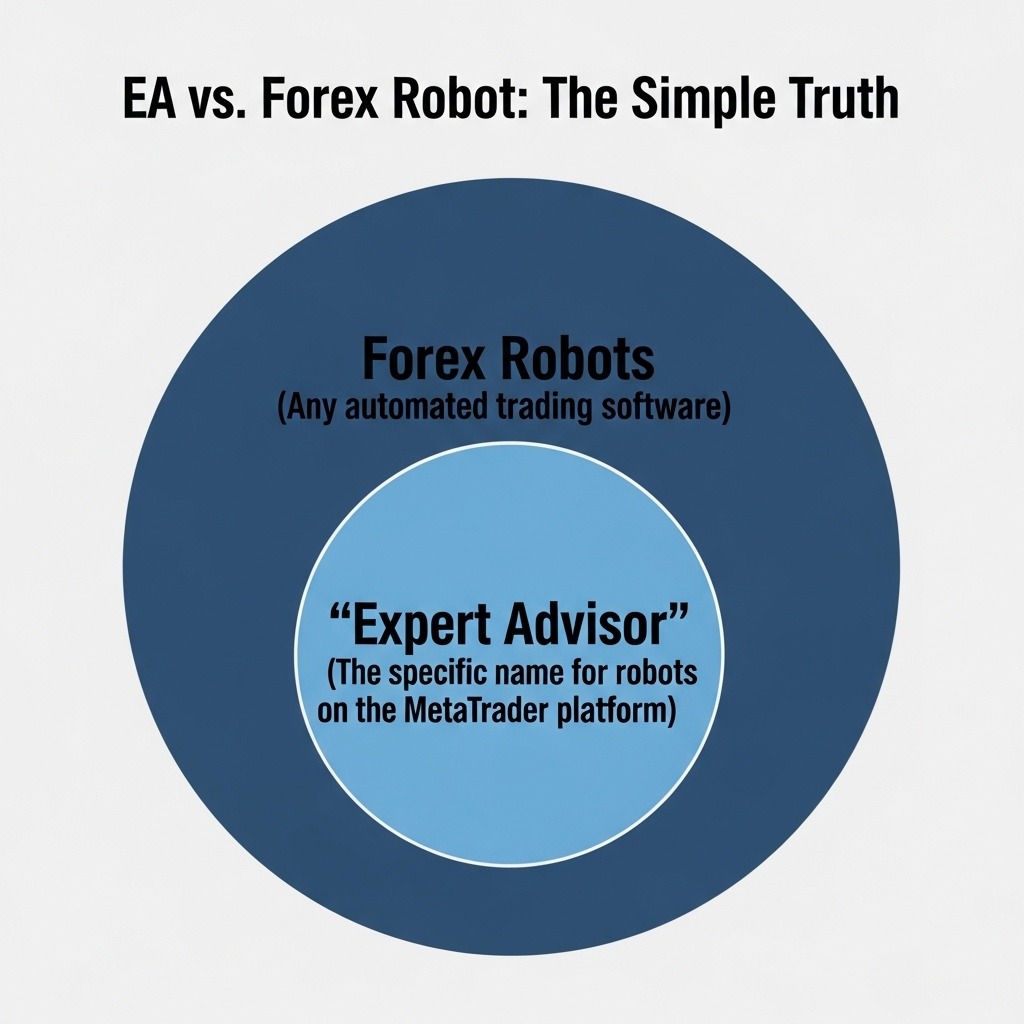
Here is the simple, absolute truth: All Expert Advisors are Forex Robots, but not all Forex Robots are Expert Advisors.
Think of it like this: “Soda” is the generic term for a carbonated soft drink. “Coke” is a specific brand of soda.
- Forex Robot is the generic term. It refers to any piece of software designed to automate forex trading on any platform.
- Expert Advisor (EA) is simply MetaTrader’s specific, trademarked brand name for a trading robot that is built to run on their MT4 and MT5 platforms.
So, if your automated trading software runs on MetaTrader, it’s an EA. If it runs on cTrader, NinjaTrader, or a custom-built platform, it’s just called a trading robot, trading bot, or automated strategy. They perform the same function, but the name “Expert Advisor” belongs to the MetaTrader ecosystem.
What an EA Means for You: The Pros vs. Cons
Understanding the technical definition is one thing; understanding the practical impact on your trading life is another. An EA is a tool, and like any powerful tool, it has distinct advantages and serious disadvantages. You must weigh them both objectively.
The Pros (The Promise of Automation)
- Eliminates Emotional Trading: This is perhaps the most significant benefit. EAs are immune to fear and greed. They execute their programmed strategy flawlessly every time, preventing impulsive decisions and revenge trading that destroy many accounts.
- Operates 24/7: The forex market is open 24 hours a day, five days a week. An EA never sleeps, gets tired, or misses an opportunity because it’s in a different time zone.
- Saves Time & Frees You From Screens: For busy professionals, this is a major draw. An EA shifts your role from an active, screen-watching trader to a system manager. Your job becomes monitoring performance and making strategic adjustments, not staring at charts all day.
- Instant Execution Speed: An EA can react to a signal and send an order to your broker in milliseconds, far faster than a human can perceive the signal, move a mouse, and click a button.
The Cons (The Harsh Reality)
- Requires Technical Stability: An EA is useless if your home computer loses power or your internet connection drops. This is why most serious EA traders use a Virtual Private Server (VPS)—a remote computer that runs 24/7—to ensure constant uptime.
- Not ‘Set-and-Forget’: The biggest myth is that you can turn on an EA and walk away. A quality EA requires significant initial backtesting (testing on historical data) and forward testing (testing on a demo account in live conditions) before you should ever risk real money. It also needs ongoing monitoring.
- Cannot Adapt to Sudden News: EAs are typically based on technical analysis. They cannot read the news or understand the context of a surprise interest rate announcement from a central bank. During extreme market volatility caused by fundamental events, a purely technical EA can suffer significant losses.
- High Risk of Over-Optimization: This is a subtle but deadly trap. It’s easy to tweak an EA’s parameters until it shows phenomenal results on past data. This is called “curve-fitting.” Unfortunately, a strategy that is perfectly tailored to the past is often fragile and fails miserably when faced with live, unpredictable market conditions.
Analyst’s Note: A common beginner mistake is buying a complex EA without understanding its core strategy. My rule: If you can’t explain the EA’s logic in one sentence, you shouldn’t be trading real money with it. Simplicity and understanding are your allies in automated trading.
To learn how to properly test, manage, and select a safe EA, refer to the in-depth walkthroughs in our Beginner’s Bible for Expert Advisors.
The Real Forex EA Meaning: Is It Right for You?
So, what is the true forex ea meaning? It’s far more than just a piece of software. It’s a tool that, when used correctly, enforces discipline, removes emotion, and perfectly automates a specific, rule-based strategy. But it is absolutely not a magic money machine or a shortcut to riches.
An EA transforms you from a button-clicker into a system manager. Your new job becomes testing, monitoring, and having the wisdom to know when to turn the system on or off. It requires a different skill set—one focused on analysis, risk management, and patience.
Before you go any further, ask yourself these honest questions:
- Do you have a profitable trading strategy that can be defined by clear, objective rules?
- Are you willing to dedicate the time to learn the basics of backtesting and risk management before going live?
- Do you understand that an EA is a tool to execute a strategy, not to create profit out of thin air?
If you answered yes to these questions, then exploring an Expert Advisor could be a logical next step in your trading journey. If you answered no, then focusing on developing your manual trading skills first is the most responsible path forward.
