






How Does a Forex Robot Work? A Plain-English Beginner Guide

A forex robot is software that reads market data and follows pre-set trading rules. It does not think or predict by instinct. When its coded conditions are met, it can place and manage trades automatically — or in some configurations, simply alert the trader to a potential setup.
Most retail forex robots run as Expert Advisors (EAs) inside MetaTrader 4 or MetaTrader 5, connected to a live trading account through your broker. Automation can speed up execution and enforce rules consistently, but it does not remove trading risk or guarantee profit.
What a forex robot actually is
A forex robot is a program built to follow trading instructions automatically — usually based on technical conditions, timing filters, and risk rules. “Expert Advisor” is simply the MetaTrader term for this type of program.
It can execute with speed and consistency that a human trader cannot match manually, but it is not adaptive or predictive in any human sense. It does exactly what its code says, nothing more.
Fully automated vs signal-only modeF
Not every robot places trades on your behalf. The two main operating modes:
- Signal-only: The robot identifies a potential setup and notifies the trader, who then decides whether to act.
- Fully automated: The robot opens, modifies, and closes trades without manual input.
Which mode applies depends on how the software is configured and what execution permissions it has been given on the platform.
What inputs a forex robot uses to make decisions
A forex robot acts only on what its code is programmed to check. It does not read news, sense market mood, or apply judgment — it reads data and tests conditions.
Typical inputs include:
- Live price data and candle patterns
- Technical indicator values (moving averages, RSI, Bollinger Bands, etc.)
- Time-of-day filters (e.g., only trade during London session)
- Spread conditions (e.g., do not trade if spread exceeds X pips)
- Account or position state (e.g., maximum open trades)
Risk rules are also coded in directly: lot size, stop-loss distance, take-profit targets, and conditions under which the robot should do nothing.
Example of a simple rule set
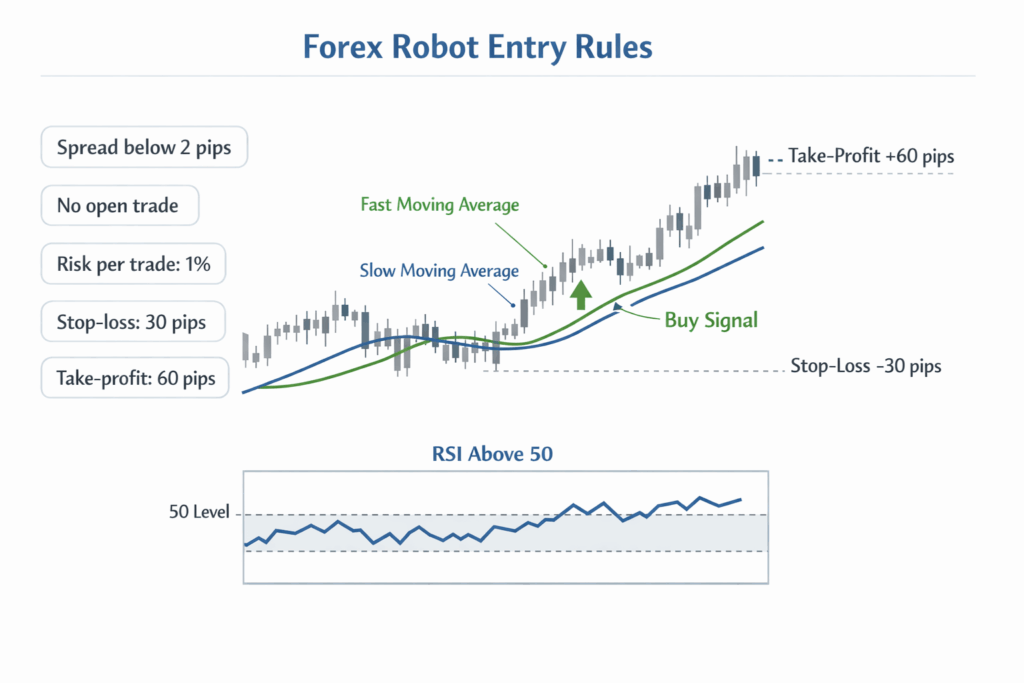
To make this concrete, here is what a basic rule set might look like:
Buy when the fast moving average crosses above the slow moving average and RSI is above 50 and current spread is below 2 pips and no position is already open.
→ Place stop-loss 30 pips below entry, take-profit 60 pips above entry, position size based on 1% account risk.
⚠️ This is an illustration only — not a recommended strategy. Real rule sets vary widely in complexity.
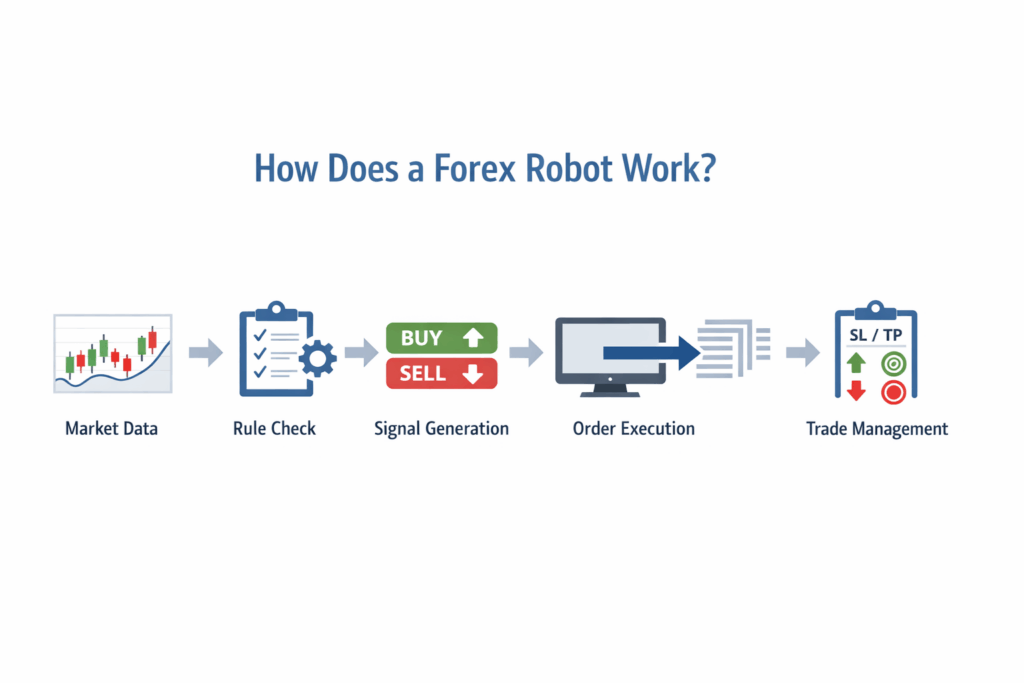
How the robot works step by step: scan, signal, execute, manage
Once the robot is running and connected to the platform, it follows the same cycle continuously.
1) Market scanning
The robot checks incoming price updates against its programmed conditions on every tick or candle close — depending on how it is built. It only sees what the platform data feed and its own code allow it to see. There is no broader market awareness outside of that.
2) Signal generation
A signal appears when all required conditions are satisfied at the same time. If even one condition fails — spread too wide, wrong session, indicator not aligned — no signal is generated and no trade is attempted. The robot does not override its own rules.
3) Order execution
When a signal triggers in automated mode, the platform sends an order request to the broker using the active account connection. The final fill — entry price, partial execution, or rejection — depends on live execution conditions at that moment, not just the code.
4) Trade management
The robot’s job does not end at entry. It can continue to monitor the open position and act on programmed instructions:
- Move or trail a stop-loss
- Close at a take-profit target
- Exit if a time-based or indicator-based rule triggers
- Scale out of the position in partial lots
Management logic is often where robot behaviour differs most noticeably from a manual trader.
Where the robot runs and how it reaches your broker
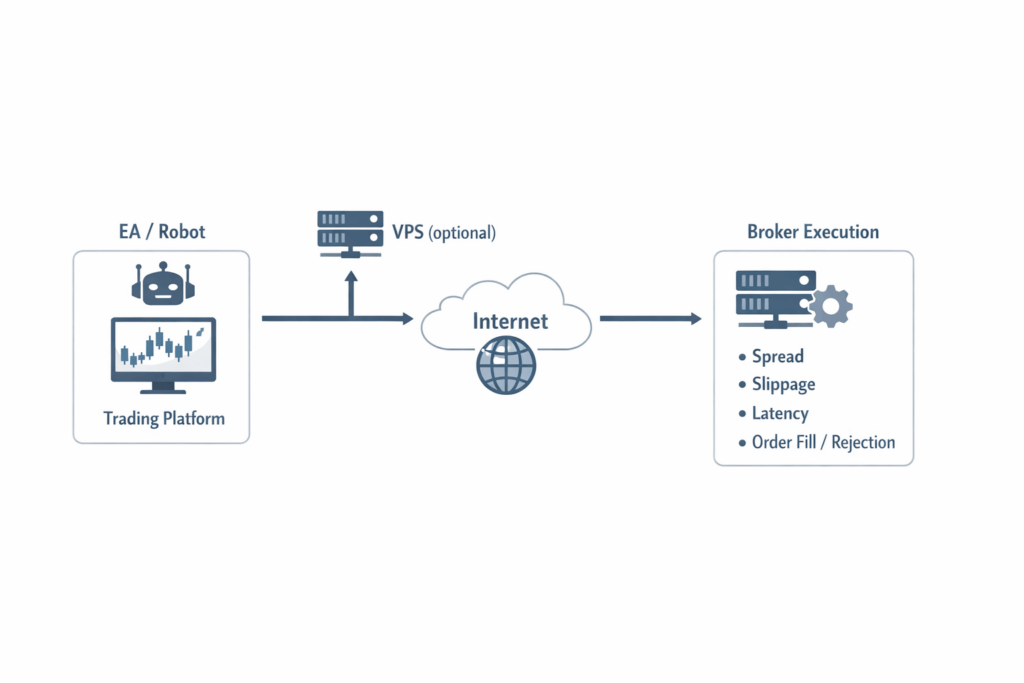
A forex robot does not operate independently. It runs inside a trading platform that is connected to your broker account. Disconnect the platform, and the robot stops.
- Most retail EAs are built for MT4 or MT5. The robot lives inside the platform, not in the cloud or on the broker’s server.
- A VPS (Virtual Private Server) is often used to keep the platform running around the clock with stable connectivity and lower latency — particularly relevant for short-term strategies where execution speed matters.
- The broker receives and fills orders based on its own execution infrastructure, not the robot’s preferences.
Why broker execution conditions matter
The same robot can behave differently across different brokers or account types. Spread, slippage, requotes, and execution speed all affect the actual entry and exit quality — sometimes significantly. This gap tends to matter more for high-frequency or scalping-style strategies than for slower, longer-timeframe approaches.
Why a forex robot can follow its rules perfectly and still lose money
This is the most important limit to understand before evaluating any robot.
- ⚠️ Automation executes a strategy — it does not improve one. If the underlying rules are weak or poorly designed, the robot will execute them efficiently and still lose.
- ⚠️ Markets change. Fixed rules that worked in one market regime may stop fitting when conditions shift — higher volatility, lower liquidity, tighter ranges, or trending instead of ranging environments.
- ⚠️ Backtests are not live results. Historical testing does not account for live spreads, slippage, latency, execution delays, or data quality differences. A result on a backtest chart is not a forecast.
- ⚠️ Emotion-free execution improves consistency, not strategy quality. Removing human hesitation is a genuine benefit — but consistent execution of a flawed strategy still loses consistently.
📌 Testing on demo or with small live exposure can help validate that the robot behaves as expected. It is not proof of future performance.
What a beginner should take away from this
Think of a forex robot as rule-based execution software, not a profit machine. The mechanism is straightforward once you understand it. The harder question is whether any specific robot’s strategy fits your broker environment, trading style, and risk tolerance — and that requires evaluation, not just activation.
If you are ready to go deeper: do forex robots really work covers realistic performance expectations, and how to install a forex robot on MT4 or MT5 walks through the setup process step by step.
