







Best Prop Firm Forex EAs in 2026: What Actually Fits?

If you are searching for the best prop firm Forex EAs in 2026, the short answer is that there is no single best robot for everyone. The EAs that tend to work best are usually the ones that fit prop firm rules, keep risk more controlled, and rely less on fragile execution conditions. That matters because major firms do allow EAs in 2026, but they do not all allow the same behaviors or execution styles.
That is why the smarter question is not simply “Which EA is best?” but “Which EA is most compatible with the firm, the account model, and the way I actually trade?” Once you frame it that way, it becomes much easier to avoid hype and focus on fit.
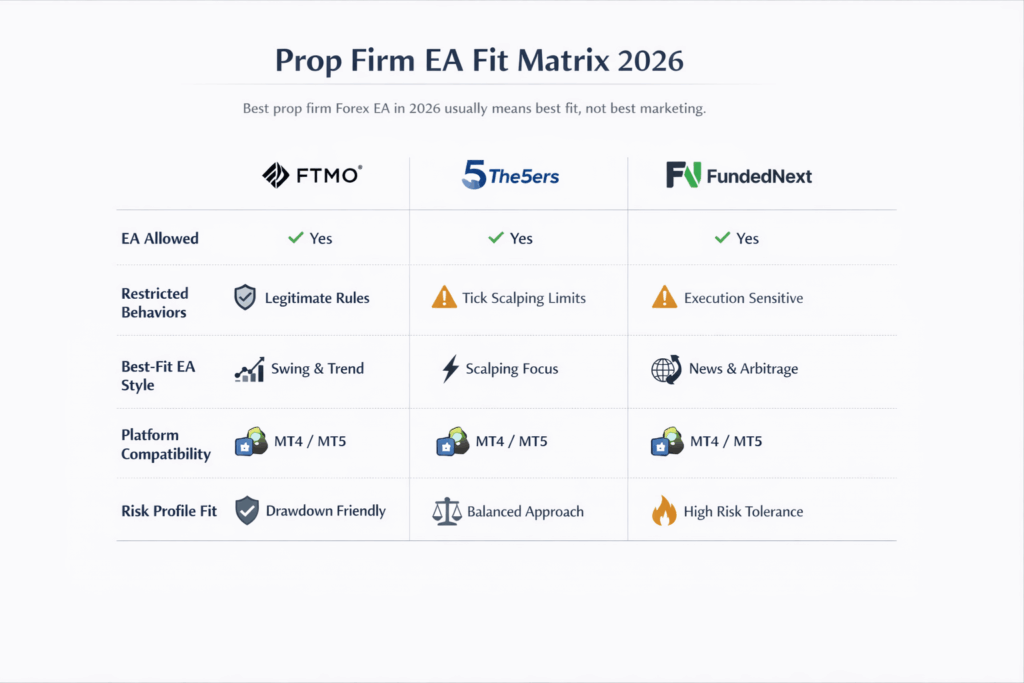
Not every profitable EA is a good prop-firm EA. The best fit depends on rules, platform support, and drawdown behavior.Is there really a “best” prop firm Forex EA in 2026?
The key point here is that “best” usually means best fit, not best marketing.
A prop firm EA that looks strong on a sales page can still be a poor choice if it struggles with daily loss limits, trailing drawdown, consistency expectations, or platform restrictions. FTMO, for example, allows EAs and algorithmic trading as long as trading is legitimate, aligns with proper risk management, and is replicable on live accounts; it also enforces strict Maximum Daily Loss and Maximum Loss objectives.
That changes how you should evaluate an EA. A retail trader on a personal account may prioritize upside and speed. A prop trader usually needs a system that can stay inside the firm’s rules first, then perform second. In other words, the best prop firm Forex EAs in 2026 are often the ones that are boring in the right ways: controlled, stable, and less likely to create sudden rule-pressure.
What makes a Forex EA prop-firm friendly in 2026?
The short answer is that a prop-firm friendly EA is usually one with controlled risk behavior, clearer strategy logic, and lower dependence on perfect execution.
The first thing to look at is how the EA behaves during losing periods. That matters more than headline performance claims. A prop firm account is often less forgiving than a personal account because daily drawdown and maximum loss thresholds can end the evaluation or funded account quickly. FTMO explicitly ties failure to breaching those limits, and that risk framework changes what kind of EA makes sense.
A more prop-friendly EA often has these traits:
- defined stop-loss behavior
- moderate position sizing
- limited simultaneous exposure
- lower dependency on spread perfection
- no explosive recovery logic
- behavior that stays understandable under stress
Another important factor is transparency. You do not need the full source code to evaluate a system intelligently, but you should know what type of strategy it is using. A trader should be able to tell whether the EA is trend-following, breakout-based, session-based, mean-reversion-heavy, grid-style, or recovery-driven. If the logic is vague and the marketing focuses only on “AI precision” or “high win rate,” that is usually not enough to make a sound prop decision.
Which EA types tend to fit prop firms better?
The main difference usually comes down to whether the EA can operate within funded-account limits without needing aggressive recovery.
In practice, the EA categories that often fit prop firms better are the ones that keep risk more predictable. That can include some trend-following EAs, breakout EAs, session-based EAs, and lower-frequency rule-based systems. These are not automatically better in every market, but they are often easier to align with rules around drawdown, consistency, and account stability.
A few reasons these types can be better fits:
- they often use clearer entry and exit logic
- they may avoid excessive trade clustering
- they can be easier to monitor
- they are less likely to need sharp exposure increases to recover losses
- they are often more adaptable to challenge-style account constraints
This is where trade-off clarity matters. A calmer EA may feel less exciting than an aggressive one, but that can be exactly what helps it survive prop firm rules. What you may give up in fast upside, you may gain in rule compatibility and account longevity.
Which EA types often create problems for prop firms?
This is where many traders run into trouble, because some of the most heavily promoted EAs are also some of the hardest to use responsibly in a prop environment.
Systems that rely on heavy recovery logic, martingale-style escalation, large trade stacking, or ultra-execution-sensitive scalping are often higher-risk fits. That does not mean every such EA is unusable, but these categories can create more friction with prop rules, especially when daily loss limits are tight or when performance depends heavily on near-perfect fills.
The5ers makes this especially clear in 2026. It allows EAs, but explicitly bans tick scalping, latency arbitrage, reverse arbitrage, hedge arbitrage, high-frequency trading, emulators, and stealth stop-losses. It also warns that accounts using those prohibited methods can be canceled, banned, and not refunded.
That illustrates the broader point: an EA can look profitable in theory and still be a bad prop choice because of how it trades. Ultra-fast, execution-fragile, or recovery-heavy systems may create more compliance and stability risk than many traders realize.
How do major prop firm rules affect EA choice in 2026?
The key thing to understand is that prop firm rules do not just influence your choice of EA; they can completely redefine it.
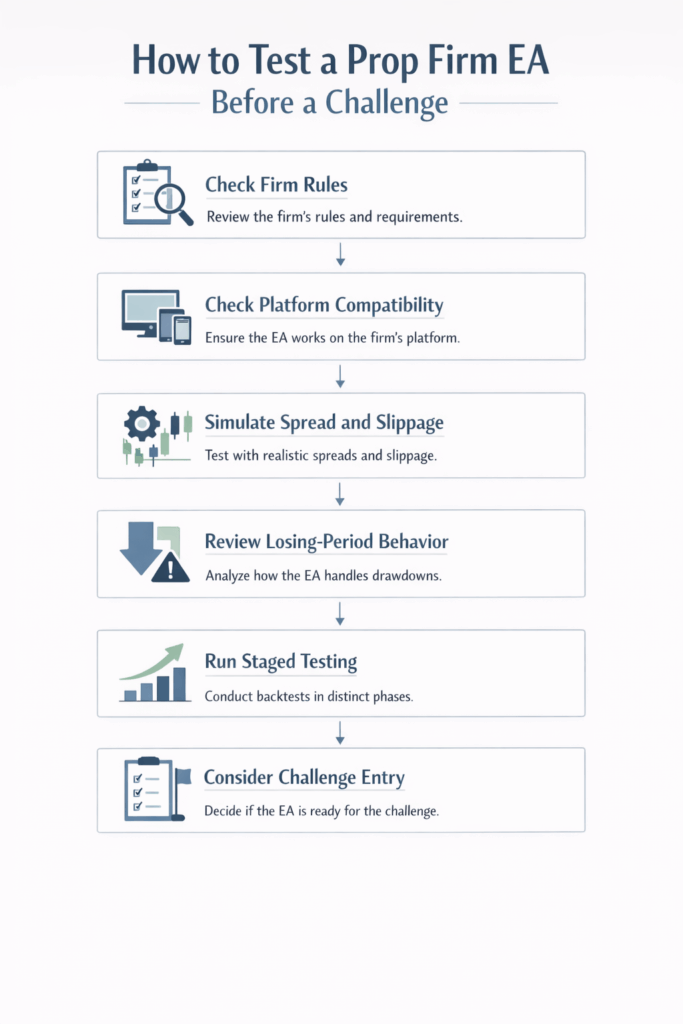
Official policy excerpts from major prop firms show why “EA allowed” does not mean every EA style is acceptable.FTMO’s published guidance says EAs and algorithmic trading are allowed if the trading remains legitimate, risk-aware, and replicable on live accounts. That means systems built around unrealistic fills, fragile latency assumptions, or abnormal behavior are harder to justify. FTMO also enforces clear drawdown objectives, which pushes many traders toward more controlled systems.
The5ers is even more specific. Its help center states that traders can use EAs, but not if they copy other people’s signals, do tick scalping, use arbitrage variants, perform HFT, use emulators, or hide stop-losses through stealth mode. That kind of language makes it obvious that “EA allowed” does not mean “every automation style is fine.”
FundedNext also allows EAs and bots on MT4 and MT5, but it ties that permission to conditions. Its help center says EAs are allowed on MT4/MT5, while a related article on Stellar Instant says there is an EA usage fee, cTrader and Match-Trader are excluded for that use case, and traders are expected to customize their EA or bot rather than run duplicated strategies.
Taken together, these policies suggest an important 2026 takeaway: the best prop firm Forex EA is often the one that is not only technically profitable, but also firm-compatible, platform-compatible, and behavior-compatible.
What should traders check before using an EA with a prop firm?
Before deciding whether an EA is a serious candidate, it helps to check the account rules first and the marketing page second.
A practical checklist should include:
1. Rule compatibility
The first step is confirming that the firm actually allows the style of automation the EA uses. “EA allowed” is not enough on its own. You need to know whether the firm restricts HFT, arbitrage behavior, stealth tools, duplicated strategies, or platform-specific automation.
2. Risk behavior
The second step is understanding how the EA behaves when trades go wrong. Does it keep position size stable, or does it escalate? Does it use clear stop-loss logic? Can exposure compound across correlated pairs? These questions often matter more than headline returns.
3. Execution sensitivity
Some EAs need very low spread, very low slippage, and stable latency to function properly. If a system is highly dependent on ideal execution, it may behave very differently in live-style prop conditions than in a clean backtest or promotional demo.
4. Platform fit
This matters more in 2026 than some traders expect. FundedNext, for example, states EA and bot use on MT4/MT5, while its Stellar Instant guidance excludes cTrader and Match-Trader for EA usage in that context. If your preferred workflow is built around a platform the firm does not support for automation, that can eliminate an EA from consideration immediately.
5. Personal fit
A final check is whether the EA actually fits your trading temperament. Some traders interfere too much with slower systems. Others panic when they see short-term drawdown, even if the risk is controlled. A good prop EA should fit both the firm and the trader.
Are prop firm Forex EAs a good fit for beginners?
The short answer is that they can be, but only if beginners understand what automation does and does not solve.
A beginner might assume that a prop firm EA removes the hard part of trading. In reality, it usually shifts the challenge. You still need to evaluate fit, monitor behavior, understand rule constraints, and set realistic expectations. The tool can automate execution, but it cannot replace judgment.
That means beginner-friendly prop EAs are usually the ones that are:
- easier to understand
- less aggressive
- easier to monitor
- less dependent on ideal conditions
- more conservative with risk
This is also where real user concern matters. A newer trader is not just asking “Can I use an EA?” They are asking, “Will I understand what this EA is doing when things go wrong?” If the answer is no, then the system may not be a good beginner fit, even if the marketing says otherwise.
How should you test a prop firm Forex EA before a challenge?
If you only want the short answer, here it is: test the EA under conditions that resemble the actual prop environment before you trust it on a challenge or funded account.
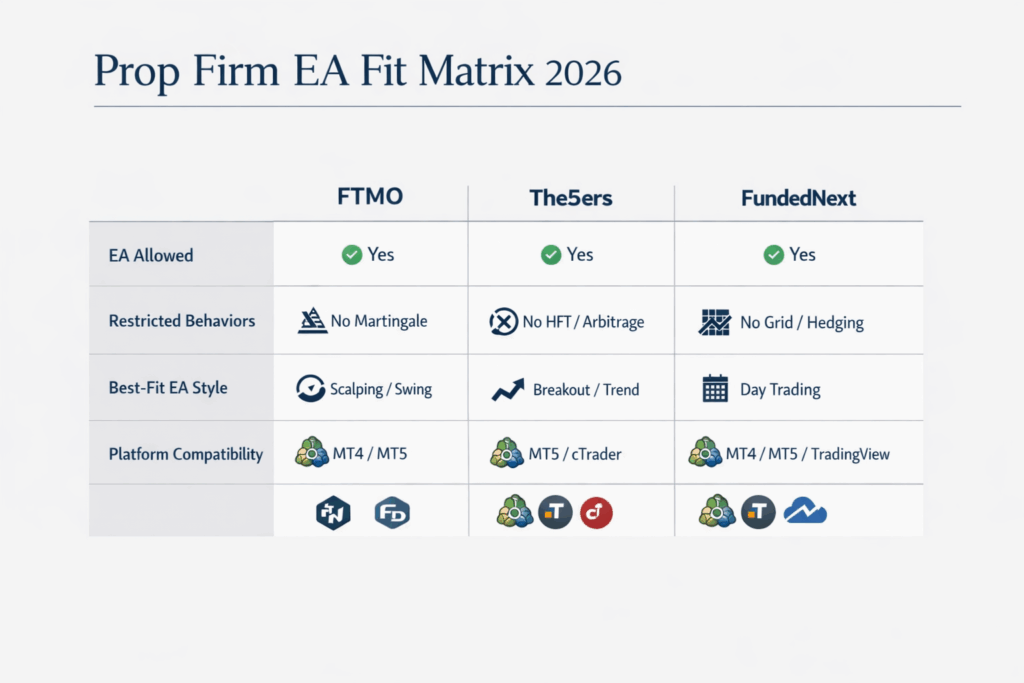
A staged validation process helps traders test EA compatibility before risking a challenge account.That means more than reviewing screenshots or a generic backtest. A useful test process should check:
- whether the EA’s style is allowed by the firm
- whether the risk stays controlled during bad periods
- whether spreads and slippage materially affect the logic
- whether the system still makes sense on the platform you will actually use
- whether the trade frequency and drawdown profile fit your own tolerance
A staged approach often works better than jumping straight into a challenge. Start by validating rule compatibility, then test the system in realistic execution conditions, then review how it behaves around loss control and consistency. The goal is not to prove that the EA can win every day. The goal is to find out whether it is stable enough to deserve prop capital.
Final verdict: what “best” really means in 2026
The core answer is that the best prop firm Forex EAs in 2026 are usually the ones that fit prop firm rules, manage drawdown more predictably, and avoid over-reliance on fragile execution or aggressive recovery logic.
That means the best choice is often not the flashiest one. It is the one that still makes sense when you account for daily loss limits, rule restrictions, platform conditions, and the way you personally handle automated risk. With firms like FTMO, The5ers, and FundedNext all allowing EAs under specific conditions, the winning mindset in 2026 is not “find the most profitable robot.” It is “find the EA that is most compatible with real prop firm constraints.”
FAQ
Can I use any Forex EA with a prop firm?
Not necessarily. Many firms allow EAs, but they may restrict specific behaviors such as HFT, arbitrage variants, stealth tools, or duplicated strategies. You need to check the firm’s policy, not just whether automation is “allowed.”
Are scalping EAs good for prop firms?
Sometimes, but they can be a higher-risk fit. The issue is usually not just scalping itself, but whether the EA depends heavily on execution quality, latency, or behaviors the firm restricts. The5ers, for example, explicitly bans tick scalping and HFT-related practices.
Is MT4 or MT5 better for prop firm EAs?
There is no universal answer, but platform support matters. FundedNext’s help center says EAs and bots are allowed on MT4 and MT5, which makes platform compatibility a practical part of the selection process.
Are prop firm Forex EAs good for beginners?
They can be, but only if the system is understandable, conservative, and easier to monitor. Beginners often do better with clearer, lower-aggression EAs than with complex high-speed systems.
Choosing the best prop firm Forex EA in 2026 is less about finding the most exciting system and more about finding one that actually fits real prop firm conditions. The traders who usually do better are not the ones chasing the boldest promises, but the ones who look closely at rule compatibility, drawdown behavior, execution sensitivity, and overall fit. If you approach EA selection with that mindset, you are far more likely to avoid costly mistakes and choose a setup that supports consistency rather than short-term hype. Before moving forward, make sure the EA you are considering fits both the prop firm’s rules and the way you actually trade.
